Fire Extinguishers
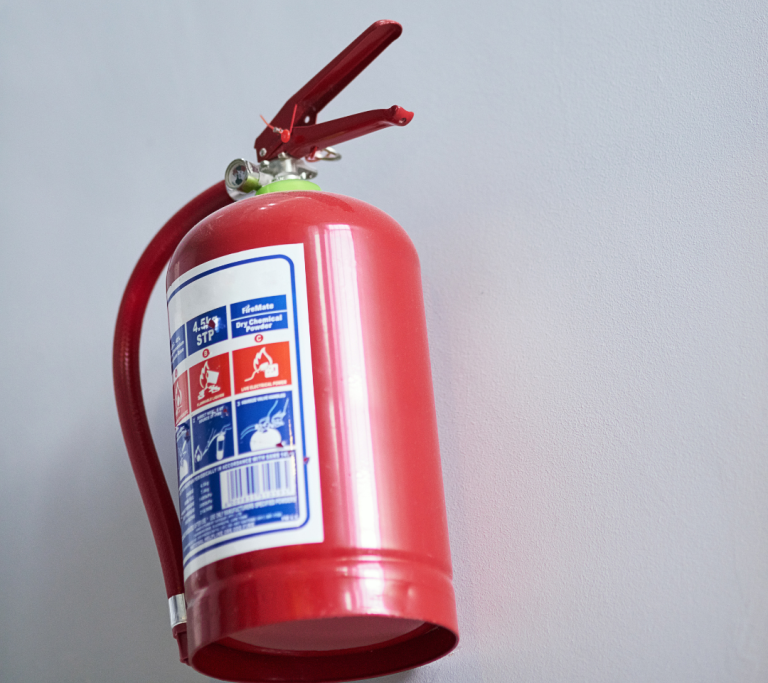
Fire extinguishers are an essential tool in the health and safety arsenal. Like all tools, however, they are all designed with specific situations in mind. While many fires can look similar, the reality is that there are many differences in fuel, heat source, and ignition, meaning that different extinguishers will be needed to combat them.
In this module, we’ll be looking at the five main categories of the extinguisher. They have several things in common, but key differences.
They have the following in common,
- Red/Stainless Steel body (the colour change has NO bearing on the type of extinguisher)
- Cylindrical shape
- Nozzle at the top
- White writing
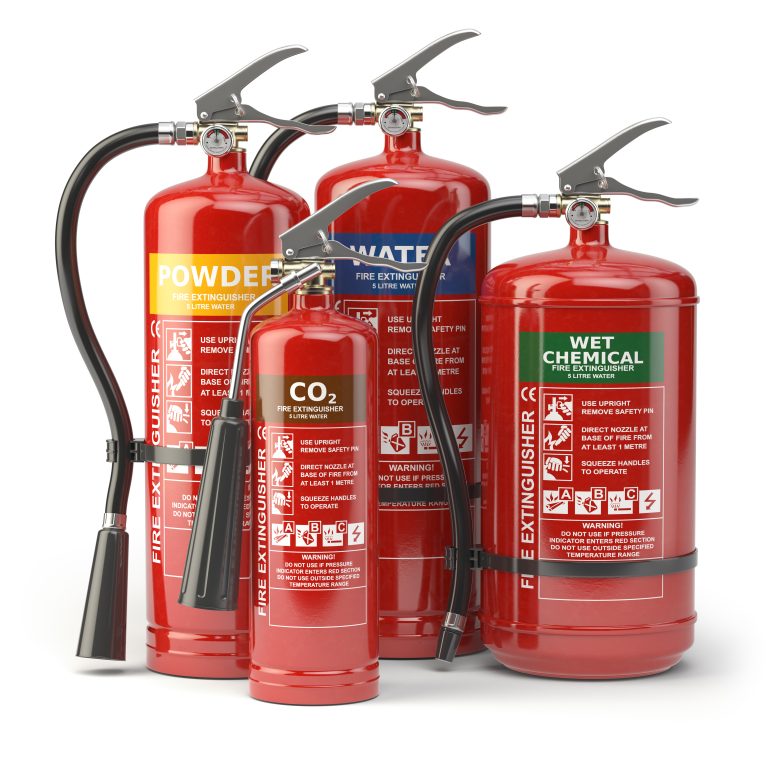
- A coloured band that tells you what each extinguisher does
- The writing’s content.
- Mounting-Some extinguishers are mounted on wheeled trolleys. These usually have a larger capacity, to be able to deal with larger fires. Most are mounted to walls on secure brackets.
Water Extinguishers
Water extinguishers are only effective on Class A fires – Fires involving burning nonmetallic solids, e.g. Paper/Wood/Cloth
Water extinguishers have two white bands wrapped around the top.
There are three distinct types of water extinguishers
- Standard Water Extinguishers – These are the most common, classic model of fire extinguishers. They store water at high pressure and spray it to cool flames, and extinguish the ignition at its source. Use on Class A fires only
- Water Spray Extinguishers – Also known as “Hydrospray” or “Water Additive”. These store water at a higher temperature and the water is laced with a variety of chemicals designed to lower water’s surface tension, allowing it to soak deeper and further into porous materials Use on Class A fires only
- Water Spray Extinguishers -Also known as “Hydro spray” or ‘Water Additive”. These store water at a higher temperature and the water is laced with a variety of chemicals designed to lower waters surface tension, allowing it to soak deeper and further into porous materials Use on Class A fires only
Powder Extinguishers
There are three separate types of chemical powder extinguishers.
ABC Powder extinguishers -The clue being in the name, they contain powdered chemicals that are effective against Class A, Class B, and Class C fires. The powders that they contain both cool and suffocate the flames, thereby dealing with two sides of the fire triangle simultaneously. DO NOT use these on Class F chip pan/oil fires
However, offices with large bodies of soft furnishings, carpets, cloth curtains, or computer equipment may want to use these extinguishers carefully. When the powder is deployed, it will leave a residue behind which is often difficult to remove.
The powder is also an inhalation hazard if you use ABC powder extinguishers in an enclosed space. If your company’s offices are not open plan, or if there are lots of small enclosed rooms, you should consider alternative extinguishers.
Mz8 and Lz powder extinguishers – These are two different types of powder extinguishers, which both have the same use. Class D fires. ONLY. The defining difference between the two is Lithium. L2 extinguishers can be used on all Class D Fires including Lithium, while M28 extinguishers can be used on all ares except Lithium.
The only there is very important. M28 and L2 powder extinguishers are designed to release their powder slowly. This is because Class D fires often involve metal filings or grains orothertypes of metal “swart” that have somehow become ignited. If the swarfis blown around by high pressure fast moving powder, it could spreadthe fire further, makings difficult situation even more dangerous.
ABC, M28, and L2 fire extinguishers are marked using a blue stripe around the top.
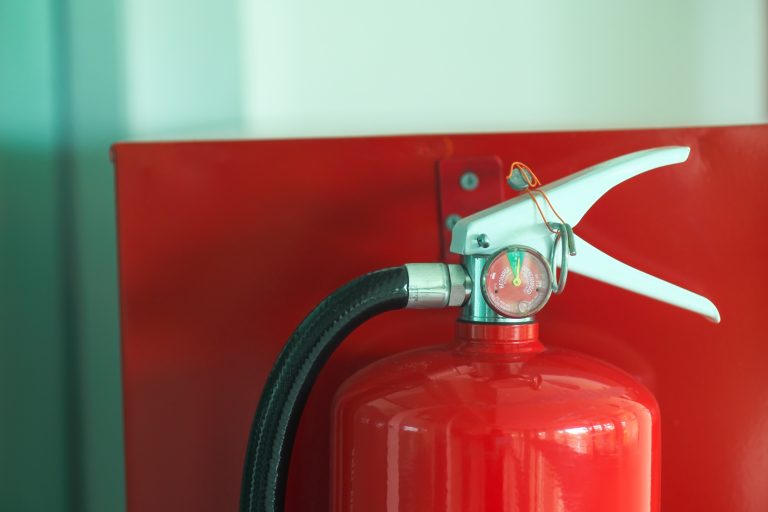
Foam extinguishers are only suitable for Class A and B fires – Non-metallic solids and Liquids.
Because of the water basis, it cannot be used on electrical fires, is not effective against metal fires, and the speed it fires at can both spread swarf and splash cooking oil – thus it is highly dangerous to use in any of these situations.
Foam Fire extinguishers are marked with an off-white / cream band around the top.
Carbon Dioxide Extinguishers
Carbon Dioxide Extinguishers, orCO2 Extinguishers, work by starving the fire of Oxygen, thereby suffocating and extinguishing it. The big advantage of these is that they do not leave any chemical residue behind, nor are they significant inhalation hazards in smaller spaces
Carbon Dioxide Extinguishers are specifically rated to work on Class B and Electrical fires ONLY. Due to the lack of residue, they are especially ideal to use on computers and other electronic equipment as they do not damage it, and there will be no residue to potentially cause reignition.
Carbon Dioxide fire extinguishers are marked by a black stripe across the top
When using a Carbon Dioxide Extinguisher on an electrical fire, ensure you have isolated the electrical circuit first. If the source of the fire had not had its supply of electricity cut off, there is a danger of reignition once the flames have been doused.
Carbon Dioxide Extinguishers use strong jets of gas out their nozzles. Consequently, they are highly unsuitable for Class D fires, where a jet of gas could send metal swarf flying and spread the fire further, or Class F fires, as the jet will again spread the boiling oil further around.
Carbon Dioxide Extinguishers can be used on Class A fires. However, they are not specifically registered to do so.
Wet ChemicaI Extinguishers
Wet Chemical Extinguishers are designed specifically to deal with Class Fires only.
In the same way as the extinguishers, M28 and L2, the chemicals contained within are sprayed slowly and carefully. Once deployed, they cool the flames and form a soap-like solution atop the ignited oil, thereby suffocating the flames and preventing reignition. The slow speed stops the oil from splashing or otherwise spreading the fire further
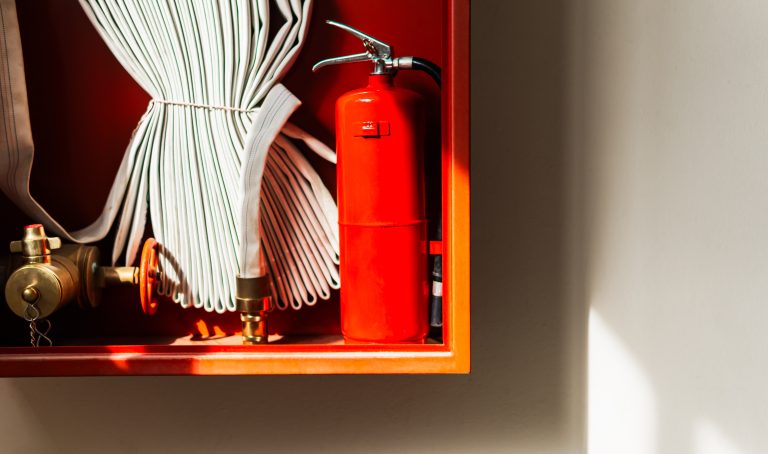
When using Wet Chemical Extinguishers, spray the contents of the canister onto the burning fats or oils in a slow, circular motion. This allows the entire container to be covered.
Although this type of extinguisher is not dangerous when used with other types of fire, it is also not very effective. It is best used on only Class F fires.
Wet Chemical Fire Extinguishers are marked using a green band across the top.
A Summary
The different types of extinguishers – what they are for, and how you can properly identify them in an emergency.
Water / Hydro spray fire extinguishers
Use on: Class A fires only
Identifying feature: Two white coloured bands/stripes around the top
Powder fire extinguishers – ABC variety
Use on: Fires of Class A, Class B, or Class C only
Identifying feature: A single blue band/stripe around the top
Powder fire extinguishers – L2 and M28 variety
Use on: Class D fires only (M28 cannot be used on Lithium, L2 can)
Identifying feature: A single blue band/stripe around the top
Specific Rules and Safety Measures
When fire extinguishers are needed, they need to be placed, used, and maintained properly;
Minimum Deployment- There should be at least one fire extinguisher installed for every zoo square metres of floor space
Minimum Access There should be at least one fire extinguisher installed on every floor
Expiration dates – There need to be regular checks to ensure fire extinguishers have not expired. Expiration can happen because pressure valves relax or chemicals go off inside the canister. A qualified fire safety specialist should visit the premises periodically to check all extinguishers are in working order.
Usage limitation – Fire extinguishers are not there to completely eliminate large fires. They are there to eliminate small fires quickly or to clear a path to an exit route or save lives. Let the fire brigade handle the fire as a whole.
Training- Of staff who are not trained start using the extinguishers, they may cause more problems than they solve. They may use the wrong extinguisher and the wrong type of fire
Instructions – Specific extinguishers will have specific instructions. Be sure always to read them carefully