Where cultures meet — and the world takes notice
We’ve reached the top.
After working through the World’s 50 Best Restaurants 2025, exploring creativity, identity, and innovation across the globe, No.1 takes us to Lima, Peru — and to a restaurant that represents far more than just great cooking.
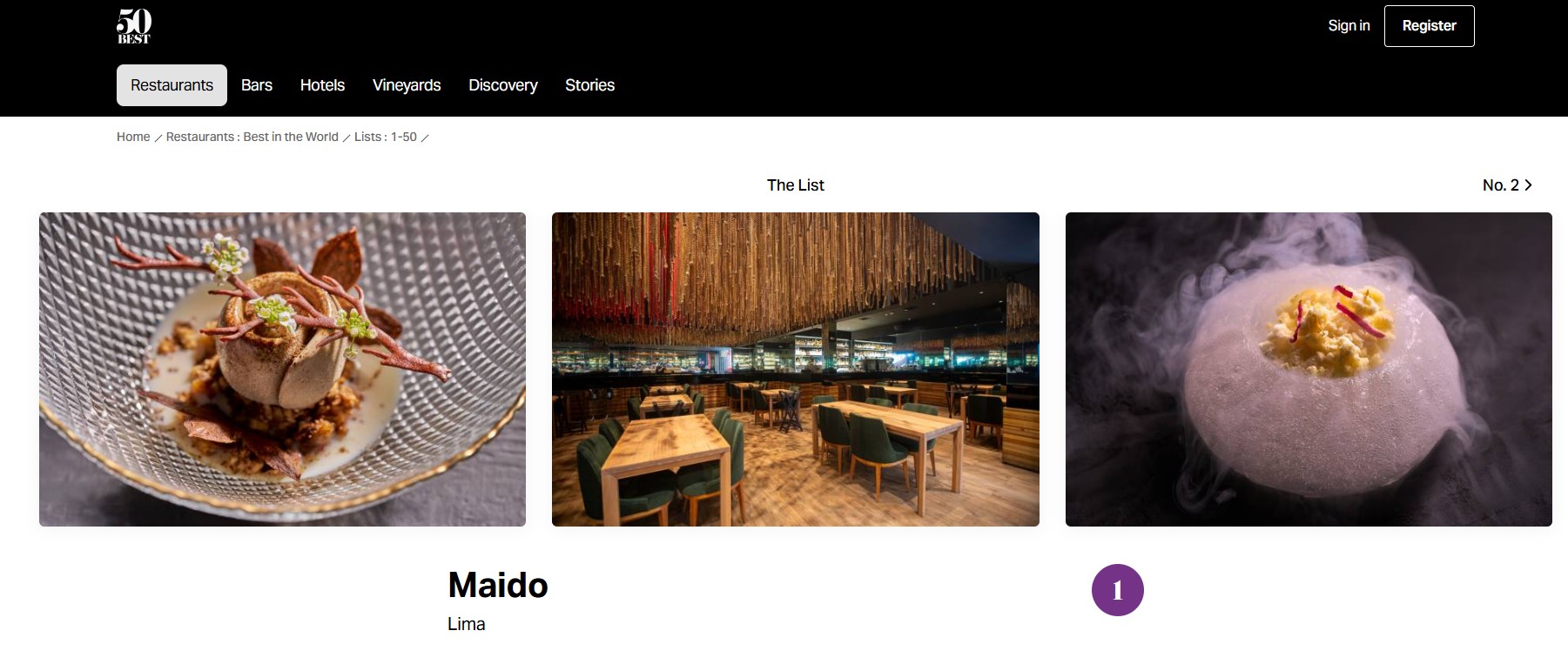
Welcome to Maido.
Named The World’s Best Restaurant 2025, Maido isn’t just a standout kitchen — it’s a restaurant that has helped define a style of cooking, elevate a culture, and reshape how the industry looks at food on a global stage.
A restaurant built on two cultures
At the heart of Maido is Nikkei cuisine — a fusion of Japanese technique and Peruvian ingredients that has evolved over more than a century.
The story begins with Japanese immigration to Peru in the late 1800s, where traditional cooking methods met completely new ingredients and landscapes. Over time, those influences combined to create something distinct — not Japanese, not Peruvian, but something entirely its own.
Maido is where that story reaches its highest level.
This isn’t fusion for the sake of it.
It’s a clear, refined expression of identity — built on history, culture, and craftsmanship.
The chef: Mitsuharu “Micha” Tsumura
Behind Maido is Chef Mitsuharu Tsumura — one of the most influential figures in modern gastronomy.
Born in Lima to Japanese parents, his career path reflects the restaurant itself:
- Culinary training in the United States
- Technical grounding in Japan, particularly in Osaka
- A return to Peru to build something of his own
He opened Maido in 2009, at just 28 years old.
And it didn’t happen overnight.
In the early years, the concept struggled. Nikkei cuisine wasn’t widely understood, and the restaurant came close to closing altogether. But through persistence — and belief in what he was building — Tsumura stayed the course.
Over time, Maido became a benchmark.
And in 2025, it reached the very top.
The philosophy: precision, product, and purpose
What makes Maido stand out isn’t just the idea — it’s the execution.
The approach is simple in principle, but refined in practice:
- Japanese precision and discipline
- Peruvian ingredients and diversity
- A focus on seasonality and evolution
The menu is built around a multi-course tasting experience, often exceeding 10 dishes, each designed to balance flavour, texture, and narrative
You might see:
- Delicate sashimi paired with Amazonian citrus
- Rich broths layered with Peruvian herbs
- Seafood prepared with traditional Japanese techniques
- Dishes referencing the Andes, coast, and rainforest in equal measure
It’s not about showing off technique — it’s about creating something that feels complete.
More than a menu — an experience
From the moment you walk in, Maido presents itself differently.
Guests are greeted with “Maido” — a Japanese welcome meaning “thanks for coming,” setting the tone immediately for the experience ahead.
The restaurant itself is elegant but understated, allowing the focus to stay where it should be: the food, the service, and the journey.
This is not a theatrical experience in the way some of the world’s top restaurants are.
It’s controlled, calm, and confident — built on detail rather than distraction.
Why Maido is No.1
Every restaurant in the top 10 has a strong identity.
What makes Maido different is how complete that identity feels.
At No.1, it represents:
- A cuisine that’s gone from niche to global
- A chef who stayed true to his vision
- A restaurant that balances creativity with consistency
Since joining the World’s 50 Best list in 2015, Maido has been a constant presence — climbing steadily before finally taking the top spot in 2025.
It’s not a one-year success.
It’s the result of long-term thinking, refinement, and belief.
The bigger picture
Maido’s position at No.1 says something important about where hospitality is heading.
It shows that:
- Cultural identity matters
- Ingredients and provenance matter
- And storytelling through food matters
But more than anything, it shows that the industry continues to move forward — shaped by chefs and teams willing to take risks, build something different, and stay consistent long enough for people to understand it.
Final thought
At Jubilee, we talk a lot about restaurants with identity.
Maido doesn’t just have one — it represents an entire movement.
From a concept that almost didn’t work, to the best restaurant in the world, it’s a reminder of what this industry can do when creativity meets resilience.
At No.1 in 2025, Maido isn’t just leading the list.
It’s setting the standard.